En el primer Safety Car de Sepang, cuatro autos quedaron fuera de la fila
Lo que muestran los datos: al relargar el primer Safety Car de Sepang, cuatro autos quedaron fuera de la fila. Uno estaba a 18,2 s del de adelante, el corte más grande de 2026.
El Safety Car es el auto de seguridad que lidera la fila cuando hay peligro en pista. La relargada es cuando sale y se reanuda la carrera.
Cuando el líder cruzó la línea de relargada, 17 autos iban en fila, a 3 s o menos entre sí. Alonso, Gasly, Bearman y Colapinto no. El hueco más grande era el de Gasly, a 18,2 s de Alonso. Con otro criterio de “fila”, Alonso entraría, pero los otros tres seguirían afuera.
Tres autos salieron de boxes tarde y no alcanzaron a la fila
Bajo ese Safety Car pararon 19 de los 21 autos. Algunos lo hicieron tarde. Gasly, Colapinto y Bearman salieron de boxes en los últimos puestos y, al llegar a la línea, seguían lejos de la cola del tren. Alonso estaba a pocos segundos.
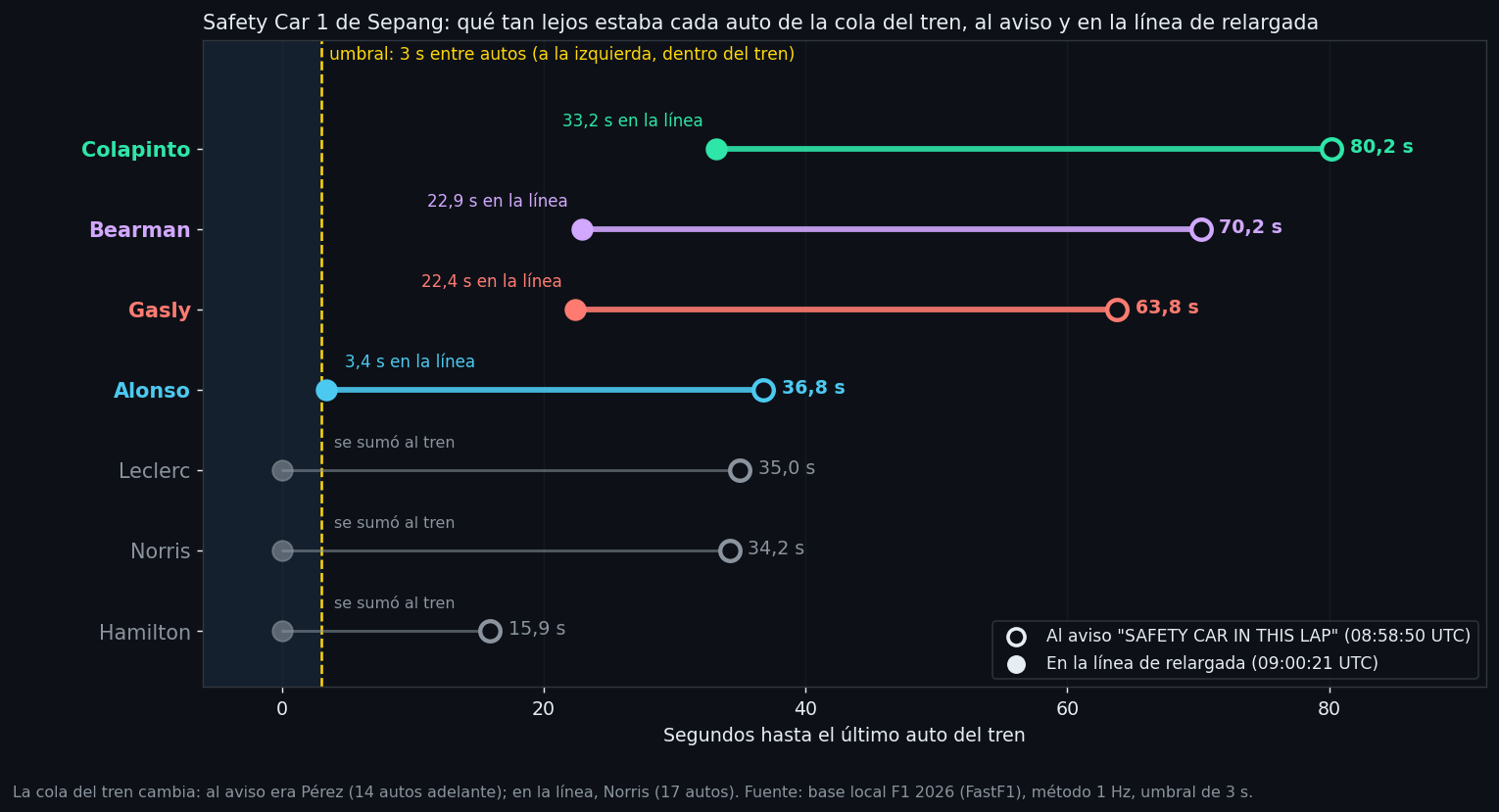
No fue falta de ritmo: los tres iban mucho más rápido que el líder, pero salían de más lejos. Por radio, la transcripción automática de MultiViewer (puede tener errores) registra a Colapinto: “We need to try and catch up here, mate” (hay que acortar la distancia). No dice nada sobre la decisión de Race Control.
El reglamento trata distinto a los autos doblados y a los que no
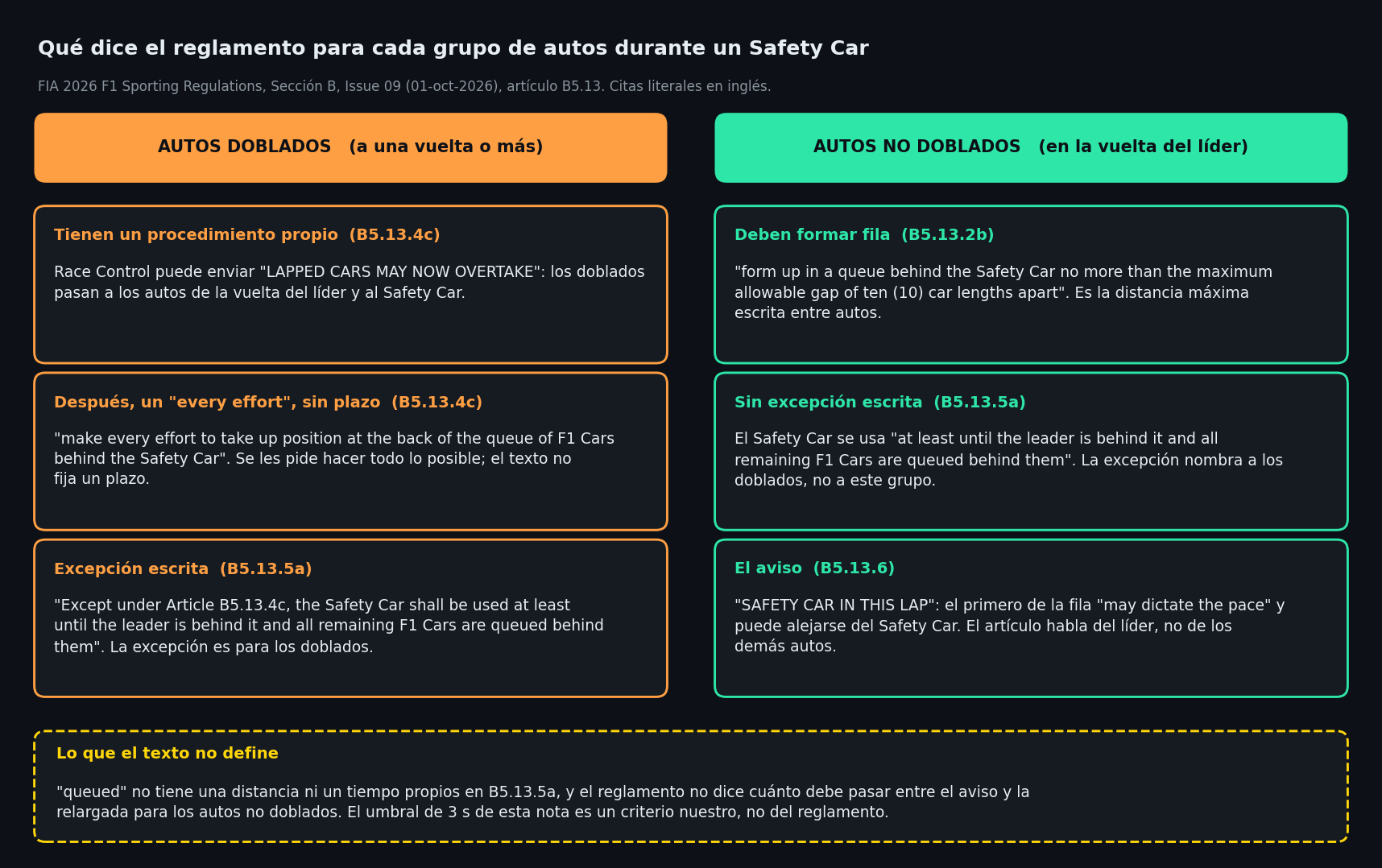
Los doblados son los autos a los que el líder ya les sacó una vuelta. Para formar la fila, el artículo B5.13.2b pide “form up in a queue behind the Safety Car” (formar una fila detrás del Safety Car). El Safety Car sigue hasta que “all remaining F1 Cars are queued behind them” (todos los autos restantes estén en fila), salvo en el caso de los doblados.
A los doblados, Race Control puede dejarlos pasar. Después deben “make every effort to take up position at the back of the queue” (hacer todo lo posible por ponerse al final de la fila), sin plazo escrito. Para los no doblados no hay excepción escrita.
En otras relargadas la fila llegó cerrada; solo Canadá 2024 se le parece
Hubo 14 Safety Car en 2026. Dejando afuera los que tuvieron doblados o terminaron en bandera roja, quedan cinco relargadas. Tres llegaron con la fila completa. Bakú tuvo un auto afuera (Bottas, tras pasar por boxes). Sepang tuvo cuatro y el corte más grande.
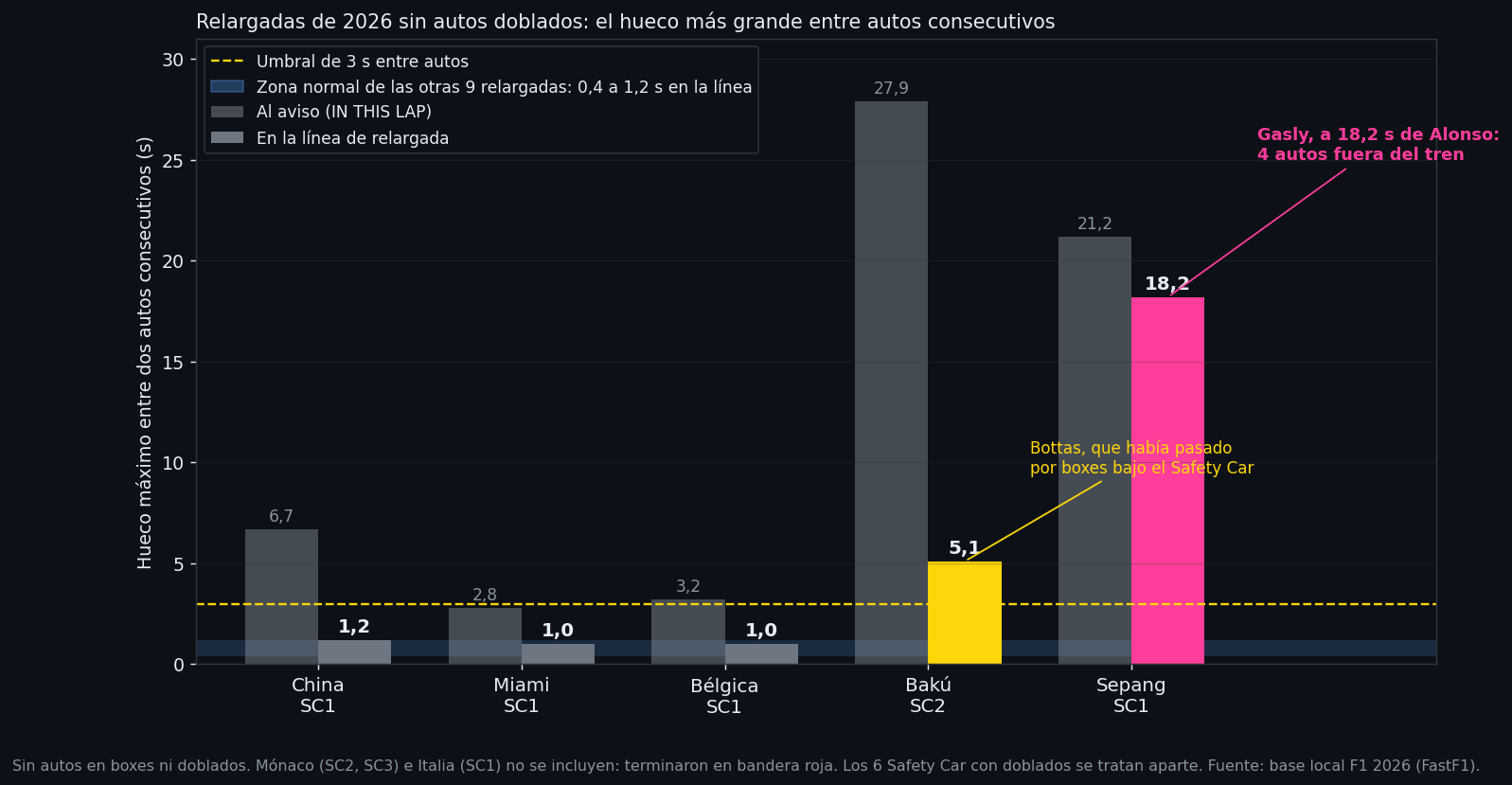
En 2024 y 2025 solo Canadá 2024 igualó a Sepang: Leclerc quedó solo, a 21,2 s, tras entrar a boxes por la lluvia. Hay una diferencia: él estaba en boxes cuando salió el aviso; en Sepang, tres autos ya habían salido minutos antes.
Qué se puede decir y qué no: se puede decir que pasó. No que Race Control infringió el reglamento ni por qué decidió así: el reglamento le da margen y la palabra “queued” (en fila) no está definida. No se midió efecto en el resultado.
En resumen: cuatro autos fuera de la fila, uno a 18,2 s.
Sepang SC1: 4 autos fuera del tren de 3 s en la línea (hueco máximo 18,2 s); no hay otro caso de 2026 sin doblados con corte mayor a 5,1 s
Definiciones. Método canonico_1hz: el hueco entre dos autos consecutivos es el tiempo que pasó desde que el de adelante estuvo en el punto de pista donde está ahora el de atrás, medido en el instante (no en un cruce de meta). Criterio de tren: 3 s o menos entre consecutivos (decisión editorial; el reglamento no define “queued”; en relargadas normales de 2026 el hueco máximo observado fue de 0,4 a 1,2 s). El primer auto con hueco mayor a 3 s corta el tren y quedan fuera él y todos los de atrás. Se excluyen autos en boxes y doblados al despliegue; una fila por auto y momento (la de menor desvío entre el segundo 1 Hz y el mensaje, máximo 0,5 s). Aviso = mensaje “SAFETY CAR IN THIS LAP”; línea = el líder cruza la meta que cierra esa vuelta. Horas en UTC (Sepang es UTC+8; hora de Diego, UTC-3).
Sepang SC1: despliegue 08:52 UTC (vuelta 9), aviso 08:58:50 (vuelta 12), TRACK CLEAR 09:00:16, línea 09:00:21 (91,8 s después del aviso). Sin doblados al despliegue (n_doblados_al_despliegue = 0). Al aviso, 7 fuera de la fila (HAM, NOR, LEC, ALO, GAS, BEA, COL); en la línea, 4 (ALO, GAS, BEA, COL). Hueco de Alonso al de adelante en la línea: 3,4 s (por encima del umbral de 3 s por 0,4 s).
B5.13.2b, B5.13.4c, B5.13.5a y B5.13.6
B5.13.2b (pág. B45): “All F1 Cars must reduce speed and form up in a queue behind the Safety Car no more than the maximum allowable gap of ten (10) car lengths apart.” Once behind the Safety Car, the first F1 Car in line must stay less than the maximum allowable gap of ten (10) car lengths behind it, except under Article B5.13.6.
B5.13.4c (pág. B46): “If the Race Director considers it safe to do so, the message” “LAPPED CARS MAY NOW OVERTAKE” “will be sent to all Competitors, and the green light on the Safety Car will be illuminated to signal to all F1 Cars that have been lapped by the leader that they are required to pass the F1 Cars on the lead lap and the Safety Car.” “(...) Having overtaken the F1 Cars on the lead lap and the Safety Car these F1 Cars should then proceed around the track at an appropriate speed, without overtaking, and” “make every effort to take up position at the back of the queue of F1 Cars behind the Safety Car”“.”
B5.13.5a (pág. B47): “Except under Article B5.13.4c, the Safety Car shall be used at least until the leader is behind it and all remaining F1 Cars are queued behind them.”
B5.13.6 (pág. B47): “When the Race Director decides it is safe to end the Safety Car period, the message” “SAFETY CAR IN THIS LAP” “will be sent to all Competitors and the orange lights on the Safety Car will be extinguished. (...) At this point” “the first F1 Car in line behind the Safety Car may dictate the pace and may fall back from the Safety Car, exceeding the maximum allowable gap between the leader and the Safety Car defined in Article B5.13.2b”“.”
Lectura. B5.13.4c da a los doblados un procedimiento de desdoblamiento y un “every effort” sin plazo; B5.13.5a exceptúa de la regla de duración solo a ese caso; para los autos no doblados no hay excepción escrita. B5.13.6 relaja el máximo de 10 largos entre el líder y el Safety Car, no entre el resto de los autos. En B5.13.5a, “queued” no tiene distancia ni tiempo propios. Comparación Issue 06 e Issue 09: las frases citadas de 2b, 4c, 5a y 6 coinciden salvo cambios de forma (“Line” pasa a “Control Line”); el Issue 09 agrega en B5.13.6 que, mientras el Safety Car no entra a boxes, ningún auto puede ir al lado de otro. Texto completo: tabla reglamento_articulos y archivo del artículo B5.13 del Issue 09.
9 carreras, 14 períodos: 6 con doblados, 3 excluidos, 5 sin doblados con relargada
| Carrera | SC | Aviso (UTC) | Línea (UTC) | Clase | Detalle |
|---|---|---|---|---|---|
| China | 1 | 2026-03-15 07:26:11 | 2026-03-15 07:28:15 | sin doblados | |
| Japón | 1 | 2026-03-29 06:00:06 | 2026-03-29 06:01:47 | con doblados (aparte) | doblados: BOT |
| Miami | 1 | 2026-05-03 17:24:07 | 2026-05-03 17:26:02 | sin doblados | |
| Mónaco | 1 | 2026-06-07 14:29:41 | 2026-06-07 14:30:51 | con doblados (aparte) | doblados: ALB ALO BOR COL GAS HAD HUL LAW LIN OCO PER PIA RUS SAI. No doblados medidos (distancia reconstruida por velocidad integrada): 0 fuera en la línea (hueco máx. 0,4 s), 2 al aviso (5,2 s) |
| Mónaco | 2 | excluido | termina con bandera roja (hubo 9 doblados) | ||
| Mónaco | 3 | 2026-06-07 15:16:42 | excluido | vuelta detrás del SC previa a la salida detenida (race_control: STANDING START), tras la bandera roja | |
| Gran Bretaña | 1 | 2026-07-05 15:27:42 | 2026-07-05 15:28:41 | con doblados (aparte) | doblados: ALO BEA BOT GAS OCO PER PIA SAI STR |
| Gran Bretaña | 2 | 2026-07-05 15:29:51 | 2026-07-05 15:31:05 | con doblados (aparte) | doblados: ALO STR |
| Bélgica | 1 | 2026-07-19 13:12:32 | 2026-07-19 13:14:05 | sin doblados | |
| Italia | 1 | excluido | bandera roja 54 s después del despliegue (no hay relargada tras SC) | ||
| Azerbaiyán (Bakú) | 1 | 2026-09-26 12:09:15 | 2026-09-26 12:11:25 | con doblados (aparte) | doblados: BOT |
| Azerbaiyán (Bakú) | 2 | 2026-09-26 12:17:06 | 2026-09-26 12:19:01 | sin doblados | |
| Malasia (Sepang) | 1 | 2026-10-04 08:58:50 | 2026-10-04 09:00:21 | sin doblados | |
| Malasia (Sepang) | 2 | 2026-10-04 10:11:34 | 2026-10-04 10:13:21 | con doblados (aparte) | doblados: BOR PER SAI |
Mónaco SC3: race_control marca “SAFETY CAR LIGHTS ON” y “STANDING START” tras la bandera roja. Italia SC1: bandera roja 54 s después de “SAFETY CAR DEPLOYED”. Mónaco SC1 (14 doblados) se midió con posiciones reconstruidas: el feed de posiciones termina a las 14:00:14 UTC, así que la distancia sale de integrar la velocidad (fuente_distancia = velocidad_integrada, error mediano 0,1 s). Solo hay 3 autos no doblados (LEC, ANT, HAM): al aviso 2 fuera de la fila (hueco máx. 5,2 s), en la línea ninguno (0,4 s). Para los SC con doblados, los huecos se calcularon solo entre los autos en la vuelta del líder.
| Relargada | Momento | Autos | Fuera de la fila (3 s) | Hueco máx. s (auto de atrás) |
|---|---|---|---|---|
| China SC1 | aviso | 17 | 1: HAD | 6,7 (HAD) |
| China SC1 | línea | 17 | 0 | 1,2 (HUL) |
| Miami SC1 | aviso | 18 | 0 | 2,8 (HAM) |
| Miami SC1 | línea | 18 | 0 | 1,0 (BEA) |
| Bélgica SC1 | aviso | 21 | 10: ALB,HUL,SAI,ALO,STR,BEA,PER,BOT,OCO,HAD | 3,2 (ALB) |
| Bélgica SC1 | línea | 21 | 0 | 1,0 (GAS) |
| Azerbaiyán (Bakú) SC2 | aviso | 16 | 2: LAW,BOT | 27,9 (BOT) |
| Azerbaiyán (Bakú) SC2 | línea | 16 | 1: BOT | 5,1 (BOT) |
| Malasia (Sepang) SC1 | aviso | 21 | 7: HAM,NOR,LEC,ALO,GAS,BEA,COL | 21,2 (GAS) |
| Malasia (Sepang) SC1 | línea | 21 | 4: ALO,GAS,BEA,COL | 18,2 (GAS) |
La banda de 0,4 a 1,2 s corresponde a las otras 9 relargadas con datos completos (3 sin doblados y 6 con doblados, incluido Mónaco SC1), en la línea. Bakú SC2: Bottas pasó por boxes bajo el Safety Car; con umbral de 8 s quedaría dentro del tren (hueco 5,1 s). Los 4 casos de Sepang SC1 no cambian con umbrales de 5 a 15 s, salvo Alonso (dentro con 5 s o más).
Brecha a la cola del tren y velocidad entre el aviso y la línea
| Piloto | Posición aviso → línea | Al líder s (aviso → línea) | A la cola s (aviso → línea) | km/h medios aviso-línea (ponderada / por distancia / muestras) |
|---|---|---|---|---|
| HAM | 15 → 15 | 27,4 → 9,0 | 15,9 → | 148 / 145 / 147 |
| NOR | 16 → 17 | 48,6 → 11,1 | 34,2 → | 176 / 173 / 176 |
| LEC | 17 → 16 | 49,5 → 11,1 | 35,0 → | 178 / 174 / 178 |
| ALO | 18 → 18 | 51,9 → 14,5 | 36,8 → 3,4 | 180 / 175 / 180 |
| GAS | 19 → 19 | 76,7 → 48,0 | 63,8 → 22,4 | 179 / 181 / 177 |
| BEA | 20 → 20 | 79,1 → 49,0 | 70,2 → 22,9 | 181 / 185 / 179 |
| COL | 21 → 21 | 93,5 → 63,3 | 80,2 → 33,2 | 185 / 187 / 187 |
| PER | 14 → 14 | 12,5 → 8,8 | → | 119 / 118 / 119 |
| ANT | 1 → 1 | 0,0 → 0,0 | → | 110 / 111 / 108 |
Cola del tren: Pérez al aviso (14 autos), Norris en la línea (17). La velocidad se calcula de tres maneras (media ponderada por tiempo de la telemetría, distancia 1 Hz sobre tiempo, y media simple de muestras) y el rango de las tres es el que se cita. Líder entre aviso y línea: 108 a 111 km/h; Gasly, Bearman y Colapinto: 177 a 187; Alonso, Norris y Leclerc: 173 a 180.
Sensibilidad al umbral en la línea (tabla sc_sensibilidad_umbral):
| Umbral | Autos en el tren | Cola | Fuera | Fuera (s a la cola) |
|---|---|---|---|---|
| 2 s | 17 | NOR | 4 | COL+33.2 BEA+22.9 GAS+22.4 ALO+3.4 |
| 3 s | 17 | NOR | 4 | COL+33.2 BEA+22.9 GAS+22.4 ALO+3.4 |
| 5 s | 18 | ALO | 3 | COL+28.9 BEA+18.8 GAS+18.2 |
| 8 s | 18 | ALO | 3 | COL+28.9 BEA+18.8 GAS+18.2 |
| 15 s | 18 | ALO | 3 | COL+28.9 BEA+18.8 GAS+18.2 |
Cronometraje oficial por cruce de meta (otro método): al cruzar el líder, Gasly llegó a la meta 26,7 s después, Bearman 27,8 s y Colapinto 35,5 s; Gasly a 18,7 s del último de la fila (Alonso, a 7,9 s del líder). Reloj de Leclerc: FastF1 trae su columna Time corrida -19,59 s respecto de Sector3SessionTime en las 55 vueltas; con el reloj crudo cruzaría la meta 26,9 s detrás del líder (casi como Gasly); corregido, 7,1 s, dentro del tren. Está corregido en la base y registrado en anomalías.
Radio. El feed oficial estático no trae clips de Colapinto en la ventana (tabla incompleta). La cita sale de MultiViewer (AI Radio Transcriptions, BETA), leída en pantalla el 05-oct-2026 con hora local de Diego (05:59:04, UTC-3 = 08:59:04 UTC): “Mate, safety car will be in at the end of this lap they're on. So they're currently turn 6. We need to try and catch up here, mate.” Quien habla en la cita es el equipo, no Colapinto. Transcripción automática sin audio verificado por nosotros: puede equivocar palabras.
19 de 21 autos pararon bajo el Safety Car; Gasly, Colapinto y Bearman entraron después de los primeros 13
| Piloto | Vuelta | Entra (UTC) | Sale (UTC) | s desde el despliegue | s entre la entrada y el aviso | s entre la salida y el aviso |
|---|---|---|---|---|---|---|
| ANT | 9 | 08:52:35 | 08:53:03 | 19 | 375 | 347 |
| VER | 9 | 08:52:36 | 08:53:03 | 20 | 374 | 346 |
| RUS | 9 | 08:52:40 | 08:53:09 | 25 | 369 | 341 |
| HAD | 9 | 08:52:49 | 08:53:18 | 34 | 360 | 332 |
| LAW | 9 | 08:52:58 | 08:53:27 | 43 | 351 | 323 |
| OCO | 9 | 08:53:00 | 08:53:28 | 44 | 350 | 321 |
| SAI | 9 | 08:53:04 | 08:53:36 | 48 | 346 | 314 |
| LIN | 9 | 08:53:05 | 08:53:33 | 50 | 345 | 316 |
| ALB | 9 | 08:53:11 | 08:53:44 | 56 | 338 | 306 |
| PIA | 9 | 08:53:12 | 08:53:42 | 57 | 337 | 308 |
| BOR | 9 | 08:53:13 | 08:53:41 | 57 | 337 | 309 |
| STR | 9 | 08:53:16 | 08:53:44 | 60 | 334 | 306 |
| PER | 9 | 08:53:24 | 08:53:54 | 69 | 325 | 295 |
| NOR | 9 | 08:54:04 | 08:54:35 | 108 | 286 | 255 |
| LEC | 9 | 08:54:09 | 08:54:38 | 114 | 281 | 252 |
| ALO | 9 | 08:54:17 | 08:54:45 | 121 | 273 | 245 |
| GAS | 9 | 08:54:34 | 08:55:02 | 139 | 255 | 227 |
| COL | 9 | 08:54:47 | 08:55:15 | 152 | 242 | 214 |
| BEA | 10 | 08:56:59 | 08:57:28 | 284 | 110 | 82 |
Fuente: tabla paradas (lap_in, pit_in_utc, pit_out_utc, estado_pista_al_entrar = SC en las 19). Al salir de boxes, Gasly iba 20.º (17,4 s del de adelante), Colapinto 21.º y Bearman 20.º (1 Hz, 3 s después de la salida). Cantidad de autos que pararon bajo otros SC sin doblados (autos distintos):
| Safety Car (sin doblados) | Autos que pararon | De ellos, después de 100 s del despliegue |
|---|---|---|
| China SC1 | 9 | 1 |
| Miami SC1 | 4 | 4 |
| Bélgica SC1 | 5 | 1 |
| Bakú SC2 | 17 | 2 |
| Sepang SC1 | 19 | 6 |
Con tren de 3 s y solo autos no doblados, un único caso iguala el hueco de Sepang
| Safety Car | Autos | Fuera de la fila (3 s) | Hueco máx. s | Parada previa al aviso |
|---|---|---|---|---|
| Miami 2024 SC1 | 19 | MAG | 15,6 | MAG:entró 13 s antes del aviso |
| Canadá 2024 SC1 | 18 | LEC | 21,2 | LEC:entró 2 s antes del aviso |
| Bakú 2026 SC2 | 16 | BOT | 5,1 | BOT:entró 152 s antes del aviso |
| Sepang 2026 SC1 | 21 | ALO,GAS,BEA,COL | 18,2 | ALO:entró 273 s antes del aviso; GAS:entró 255 s antes del aviso; BEA:entró 110 s antes del aviso; COL:entró 242 s antes del aviso |
Se consideran los SC de carrera con mensaje IN THIS LAP (12 en 2024, 16 en 2025), autos no doblados, fuera de boxes y que siguen en carrera, en la línea de relargada. Canadá 2024 SC1: aviso 18:47:34 UTC (15:47:34 en Montreal, vuelta 29); Leclerc a 21,2 s; entró a boxes a las 18:47:31 UTC (cambio de neumáticos con lluvia) y en el video figura en boxes cuando sale el aviso; más de un minuto después el tracker lo muestra solo, a unos 23 s de Zhou (doblado), con el resto compacto. Miami 2024 SC1: aviso 20:54:50 UTC (17:54:50 en Miami); Magnussen a 15,6 s; la base lo registra entrando a boxes en la vuelta 31, 13 s antes del aviso, y en el video figura en boxes alrededor del aviso; los comisarios habían anunciado una penalización de 10 s a las 17:53:17 por causar una colisión (no se verificó que la haya servido en boxes); el resto, compacto. Revisado también en el video de MultiViewer, Race Control y datos. En esos dos casos y en Sepang, la relación con la parada es cronológica: no se afirma que la parada causara el hueco. Diferencia clave: en Canadá 2024 y Miami 2024 el auto estaba en boxes al salir el aviso (había entrado 3 y 13 s antes); en Sepang, Gasly, Colapinto y Bearman habían entrado entre 1,8 y 4,3 minutos antes y ya habían salido. No cuentan: Mónaco 2024 SC1 (salida lanzada tras la bandera roja de la vuelta 1, sin IN THIS LAP), Bélgica 2025 (arrancó detrás del SC), Canadá 2025 y San Pablo 2024 (bandera roja). Detalle por umbral en precedentes_sc_sensibilidad_umbral_tren.csv de la base: a 8 s o más quedan solo los dos casos de 2024.
Re-derivación por otra vía y alcance
| Relargada | Cifra de la nota | Re-derivada de distancia 1 Hz | Diferencia s |
|---|---|---|---|
| China SC1, aviso | 6,7 (HAD), 1 fuera | 7,2 (HAD), 1 fuera | 0,5 |
| China SC1, línea | 1,2 (HUL), 0 fuera | 1,1 (HUL), 0 fuera | -0,1 |
| Miami SC1, aviso | 2,8 (HAM), 0 fuera | 2,8 (HAM), 0 fuera | -0,0 |
| Miami SC1, línea | 1,0 (BEA), 0 fuera | 1,0 (BEA), 0 fuera | 0,0 |
| Bélgica SC1, aviso | 3,2 (ALB), 10 fuera | 3,1 (ALB), 10 fuera | -0,1 |
| Bélgica SC1, línea | 1,0 (GAS), 0 fuera | 1,0 (ALB), 0 fuera | -0,0 |
| Bakú SC2, aviso | 27,9 (BOT), 2 fuera | 28,0 (BOT), 2 fuera | 0,1 |
| Bakú SC2, línea | 5,1 (BOT), 1 fuera | 5,1 (BOT), 1 fuera | -0,0 |
| Sepang SC1, aviso | 21,2 (GAS), 7 fuera | 21,1 (GAS), 7 fuera | -0,1 |
| Sepang SC1, línea | 18,2 (GAS), 4 fuera | 18,4 (GAS), 4 fuera | 0,2 |
La re-derivación usa distancia de carrera 1 Hz de la tabla estado_auto_1hz (sin leer la tabla de momentos); la mayor diferencia es de 0,5 s (China, aviso) y todas las cuentas de autos fuera coinciden. La tabla sc_sensibilidad_umbral de la base da los mismos resultados con 3 s. Alcance: 2026 completo; 2024 y 2025 solo en la sección de precedentes, con el mismo criterio, y sin afirmar causalidad. No se afirma infracción de Race Control ni se explica su decisión; B5.13.6 le da discrecionalidad y “queued” no está definido. No se mide relación con el resultado final.
At Sepang's first Safety Car restart, four cars were outside the queue, one 18.2 s behind the car ahead
When the leader crossed the restart line (09:00:21 UTC, 17:00:21 in Sepang), 17 cars were queued up, 3 s or less apart. Alonso, Gasly, Bearman and Colapinto were not: Alonso was 3.4 s behind Norris, Gasly 18.2 s behind Alonso, Bearman 1.2 s behind Gasly and Colapinto 7.6 s behind Bearman. None was a lapped car.
We checked every Safety Car period of 2026. Of the five without lapped cars that ended in a restart, three (China, Miami and Belgium) reached the line with a complete queue. In Baku SC2 one car was outside, Bottas, 5.1 s back, after a pit stop. In Sepang four were outside: it is the only 2026 Safety Car without lapped cars that restarted with the queue broken by more than 18 s.
What can and cannot be said. We can say it happened and how large it was. We cannot say Race Control broke the regulations or why it decided as it did: Article B5.13.6 leaves it room and the regulations do not define “queued”. Nor can it be linked to the race result.
The regulations treat lapped and unlapped cars differently
Two rules apply. How the queue forms: B5.13.2b says cars must “form up in a queue behind the Safety Car no more than the maximum allowable gap of ten (10) car lengths apart”. When the Safety Car can end: B5.13.5a says it is used “at least until the leader is behind it and all remaining F1 Cars are queued behind them”, and it opens with an exception, “Except under Article B5.13.4c”.
That article covers lapped cars. Race Control may send “LAPPED CARS MAY NOW OVERTAKE”; lapped cars pass the lead-lap cars and the Safety Car, and then must “make every effort to take up position at the back of the queue”. It is a procedure of its own, with no written time limit. For unlapped cars there is no written exception: the general rule applies. The “SAFETY CAR IN THIS LAP” message (B5.13.6) lets the first car in line “may dictate the pace” and fall back from the Safety Car, but it speaks about the leader, not the rest of the field.
In the other 2026 restarts the queue reached the line closed; in Sepang SC1 it did not
There was a Safety Car in 9 of 16 races: 14 periods. Six had lapped cars (Japan, Monaco SC1, Great Britain SC1 and SC2, Baku SC1, Sepang SC2) and are looked at separately. Three ended in a red flag rather than a restart: Monaco SC2 and SC3 (the latter is the lap before a standing start) and Italy SC1 (red flag 54 s after deployment). Five remain without lapped cars: at the line, China, Miami and Belgium closed between 1.0 and 1.2 s, inside the range of the other nine measured restarts (0.4 to 1.2 s); Baku SC2 had one car outside, at 5.1 s; Sepang SC1 had four and a 18.2 s gap.
92 s passed between the message and the line: the three furthest back closed in, but did not arrive
At the “SAFETY CAR IN THIS LAP” message (08:58:50 UTC, 16:58:50 in Sepang) seven cars were outside the queue, 15.9 to 80.2 s behind the last car of the train, Perez. Six of them (Norris, Leclerc, Alonso, Gasly, Colapinto and Bearman) had stopped between 108 and 284 s after deployment; the seventh, Hamilton, had not stopped yet. By the line (91.8 s later) Hamilton, Norris and Leclerc had joined the train and Alonso was 3.4 s off it. Gasly, Bearman and Colapinto went from 63.8, 70.2 and 80.2 s to 22.4, 22.9 and 33.2 s behind the tail, which by then was Norris.
In the Sepang SC1, 19 of 21 cars pitted: 13 in the first 70 s and six later (Norris, Leclerc, Alonso, Gasly and Colapinto between 108 and 152 s; Bearman at 284 s). In the other four Safety Cars without lapped cars, 9, 4, 5 and 17 pitted. Gasly, Colapinto and Bearman left the pits among the last places.
It was not a lack of pace: between the message and the line the three averaged about 180 km/h (177 to 187 depending on the method) against about 110 for the leader, like Norris, Leclerc and Alonso (173 to 180), who joined the train or stayed 3.4 s off it. They started further back: at the message Gasly was 76.7 s behind the leader and Alonso 51.9 s.
At 08:59:04 UTC, 14 s after the message, MultiViewer's automatic transcription (BETA) records this radio message to Colapinto: “safety car will be in at the end of this lap” and “We need to try and catch up here, mate”. It may contain errors, and the clip is not in the official radio feed. It shows the team knew the group was ahead; it says nothing about Race Control's decision.
Limits. 2026 only: 2025 and 2024 are still being loaded and nothing is claimed about other years. The 3 s threshold is ours, not the regulations': at 5 s Alonso is inside the train, and Gasly, Bearman and Colapinto stay outside at any threshold up to 15 s. Leclerc's FastF1 timing is shifted by 19.6 s; it is corrected.
In 2024 and 2025, only Canada 2024 matched the Sepang gap
Using the same criterion across the 28 Safety Car periods of 2024 and 2025, only Canada 2024 SC1 matched the Sepang magnitude: Leclerc was alone, 21.2 s back at the line, with Zhou (lapped) ahead and the rest compact. He had entered the pits about 3 s before the message, for a wet-weather tyre change. Miami 2024 was smaller (Magnussen, 15.6 s), in the pits when the message came out. The difference: in those two cases the car was in the pits when the message came out; in Sepang, Gasly, Colapinto and Bearman had already left, after entering 1.8 to 4.3 minutes earlier. We also checked this in MultiViewer's video, Race Control and the data. Monaco 2024, Belgium 2025, Canada 2025 and Sao Paulo 2024 do not count (red flag or start behind the Safety Car).
Fuente: FastF1 (base local de 2026) y reglamento deportivo FIA 2026, Sección B, Issue 09. Publicado 05-oct-2026.Fuente: FastF1 (timing, posición, telemetría, race control), reglamento FIA Issue 09 (01-oct-2026), MultiViewer (radio, transcripción automática). Publicado 05-oct-2026.Source: FastF1 (2026 local database) and FIA 2026 Sporting Regulations, Section B, Issue 09. Published 05-Oct-2026.