Verstappen adelantó bajo amarilla y no lo penalizaron
Lo que muestran los datos: Verstappen levantó el acelerador, frenó y pasó a Hamilton mucho más lento que en sus otras vueltas. Lo que no se mide es si el pase era evitable.
En la clasificación sprint de Singapur, Verstappen hacía una vuelta lanzada cuando salió una amarilla. Antes de la curva 8 pasó a Hamilton, que iba más lento.
Los comisarios (Documento 29) escribieron: “Car 3 overtook Car 44 under single yellow flags” (el 3 pasó al 44 bajo amarilla simple). Y decidieron: “No penalty is applied” (no se aplica penalidad).
Sin penalidad no es sin infracción. El documento dice que Verstappen “breached the yellow flag regulation” (infringió la regla de la bandera amarilla). Y da por bueno que “reacted appropriately” (reaccionó de forma apropiada).
Los datos del auto muestran que levantó y que pasó muy lento
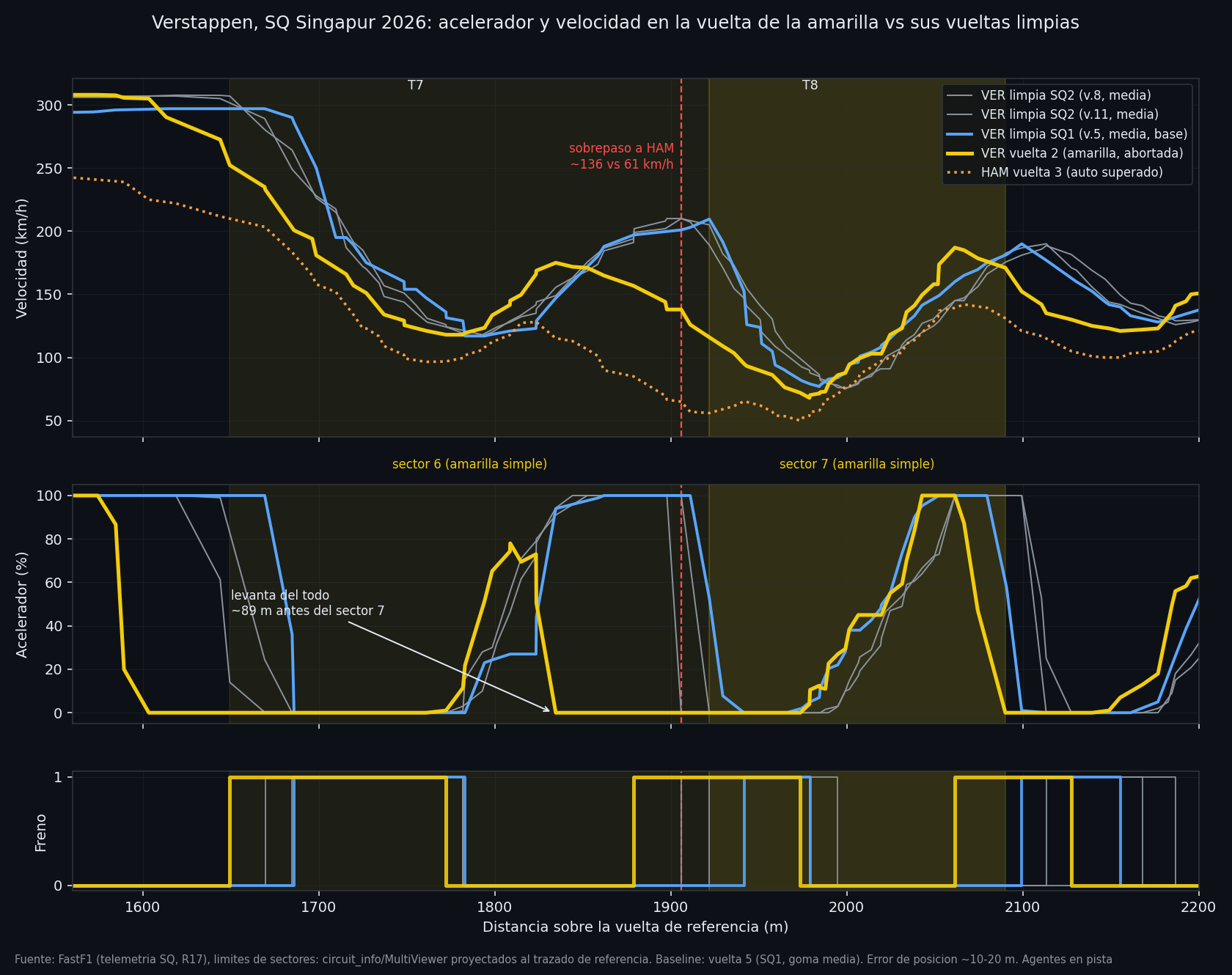
Según FastF1, Verstappen levantó el acelerador del todo antes del tramo amarillo y empezó a frenar poco después. El documento dice que pasó “some 70km/h less” (unos 70 km/h menos) que en una vuelta normal. Nuestros datos coinciden.
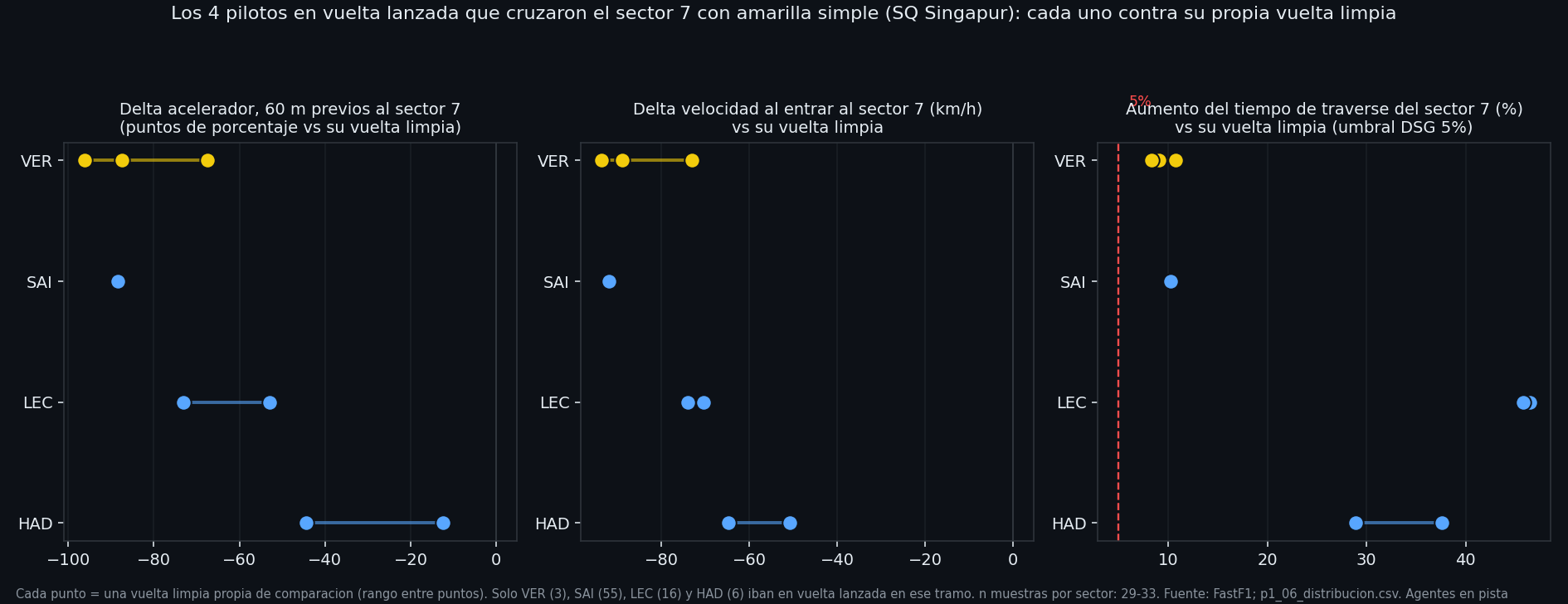
Los otros tres pilotos en vuelta lanzada con esa bandera (Sainz, Leclerc y Hadjar) también levantaron. Los cuatro tardaron más en ese sector que en su vuelta limpia. No es un ranking: llegaron a la bandera en momentos distintos.
Hay una diferencia sin resolver. El documento dice que Verstappen levantó del todo “within approximately 40 metres” (a unos 40 metros) de entrar al sector amarillo. Nosotros medimos unos 89. Coinciden en lo central: levantó antes del pase.
El reglamento prohíbe adelantar con amarilla, pero los casos anteriores no son parejos
El reglamento dice: “Overtaking is not permitted between the first yellow flag and the green flag” (no se puede adelantar entre la primera amarilla y la verde). Vale para amarilla simple y doble.
En los documentos que guardamos hubo penalidades, infracciones sin penalidad y reprimendas. Por ejemplo, Colapinto en Zandvoort 2026 recibió un drive-through.
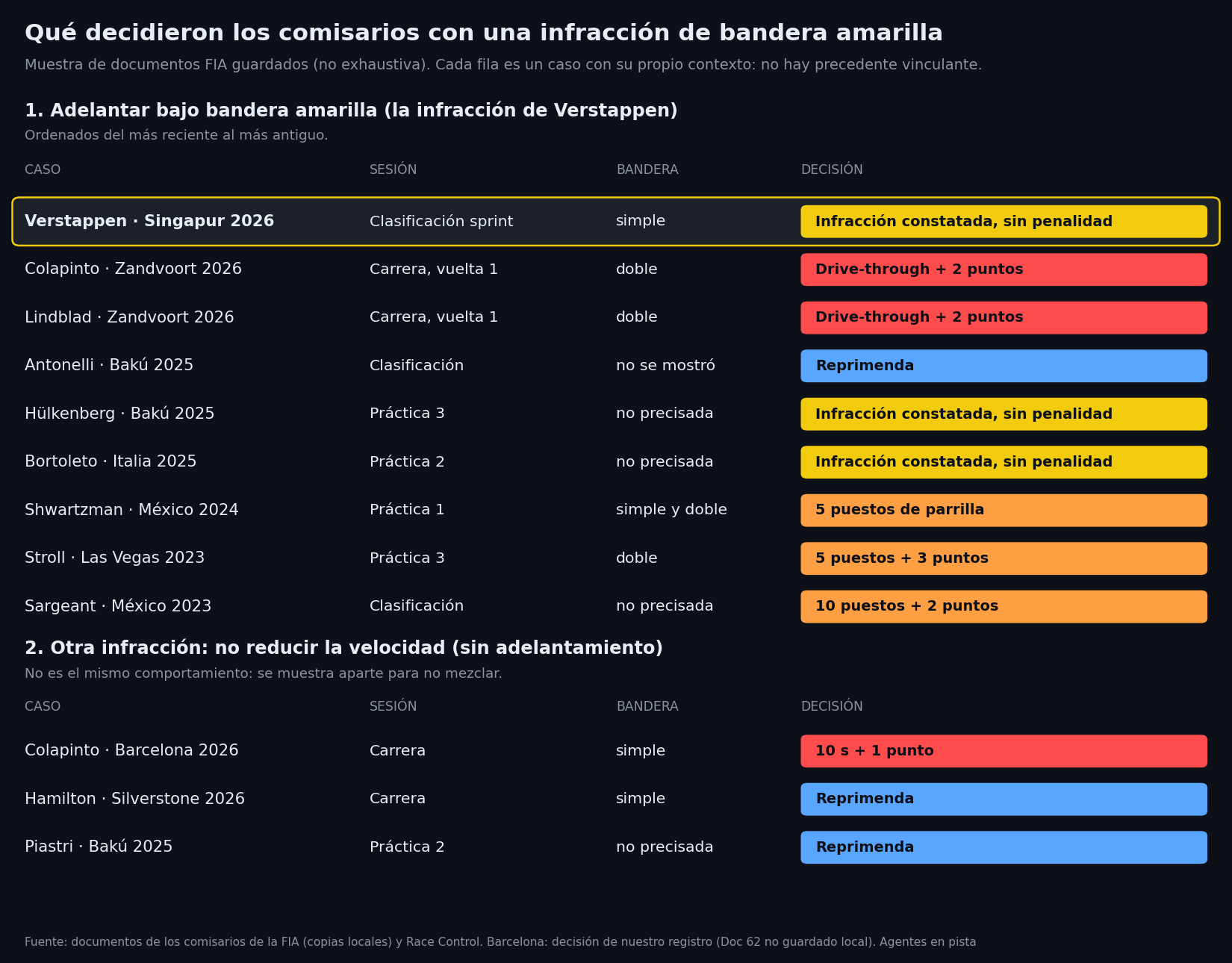
Zandvoort y Singapur no son iguales. Allá la bandera era doble; acá, simple. Allá era una vuelta de carrera con escombros; acá, una vuelta lanzada con un auto frenando adelante. No decimos que el pase de Colapinto fuera inevitable.
Qué se puede decir y qué no
Es una lectura de nuestro análisis, no un dato: la decisión es defendible con el documento y la telemetría. Pero no se puede demostrar que fue coherente con los casos anteriores.
A favor: la telemetría respalda el relato, hubo audiencia y radio, y hay infracciones sin penalidad con un atenuante escrito. Abierto: la guía de penalidades 2026 prevé 5 puestos de parrilla en este caso, aunque los comisarios “retain the discretion” (conservan la facultad) de considerar atenuantes. El atenuante central, que evitar el pase exigía “braked very heavily” (frenar muy fuerte), es el argumento del piloto aceptado por el tribunal, y la telemetría no lo mide. No tenemos la radio.
Lo que no decimos: que haya sido un error, ni que haya habido favoritismo, ni que haya sido lo correcto.
La telemetría respalda que reaccionó. Lo que no se puede medir es si el adelantamiento era evitable.
Doc 29: infracción de App. H 2.5.5b constatada y “No penalty is applied”; el texto no es un “no further action”
Documento 29 (09-oct-2026, 23:38; panel Holter, Selley, Lamy, Ng). Fact: “Car 3 overtook Car 44 under single yellow flags.” Infringement: “Breach of Appendix H, Article 2.5.5b of the FIA International Sporting Code.” Decision: “No penalty is applied.” Proceso: “summoned (documents 21 & 22) and heard from the driver and team representatives”; evidencia: “positioning/marshalling system data, video, timing, telemetry, team radio and in-car video”. Relato del tribunal: VER salía de T7 en vuelta lanzada con amarilla simple; HAM iba delante y “had been warned of Car 3’s approach”; VER pasó a HAM “prior to turn 8 while both cars were still in the yellow flag sector” y abandonó la vuelta. Determinación: “breached the yellow flag regulation by overtaking Car 44”; el pase fue “an unfortunate consequence of the significant closing speed differential” y “determined not to impose a penalty”. Hora del documento: 20:35.
Qué juzga y qué no. El Doc 29 no juzga “no reducir la velocidad” (B1.8.4a, con los umbrales de 5 % simple y 15 % doble de la Sección L de las Driving Standards Guidelines): juzga un adelantamiento. Los comisarios dan por buena la reacción (“reacted appropriately ... by lifting off throttle and reducing speed”) y aun así constatan la infracción por el pase. “No penalty” es una decisión distinta de “no further action”: aquí hay infracción constatada y no se aplica sanción.
Hora. Docs 21, 22 y 29 dicen 20:35. El mensaje de Race Control dice “(20:38:39)”; a esa hora la sesión estaba en bandera roja (roja 20:35:52; pista libre 20:38:22). La telemetría ubica a VER en T7-T8 a las 20:35:20-29 locales. Se toma la hora del documento. El peligro que originó la bandera no está identificado en el Doc 29 ni en la telemetría.
| UTC | Local | Mensaje de Race Control |
|---|---|---|
| 12:35:20 | 20:35:20 | YELLOW IN TRACK SECTOR 7 y SECTOR 6 (simples) |
| 12:35:33 y :39 | TRACK SURFACE SLIPPERY IN TRACK SECTOR 7 | |
| 12:35:37 / 12:35:41 | CLEAR sector 6; vuelve amarilla en 6 y 7 | |
| 12:35:52 | 20:35:52 | RED FLAG (limpia 6 y 7) |
| 12:40:26 | 20:40:26 | TURN 7 INCIDENT INVOLVING CAR 3 (VER) NOTED - YELLOW FLAG INFRINGEMENT (20:38:39) |
| 12:46:43 | ... WILL BE INVESTIGATED AFTER THE SESSION |
VER levantó del todo antes del sector 7 y pasó a HAM a 136 km/h, 65-74 km/h menos que en sus vueltas limpias
Método. FastF1, sesión SQ, ronda 17. Límites oficiales de marshalling sectors (get_circuit_info().marshal_sectors) proyectados al trazado de referencia: sector 6 = 1.649-1.922 m (contiene T7), sector 7 = 1.922-2.090 m (contiene T8). Error de posición estimado 10-20 m; 12 muestras en los 100 m previos y 33 dentro del sector (4-5 Hz). Baseline principal: vuelta 5 (SQ1, goma media, TrackStatus 1); la v.2 era una push real (S1 27,697 s contra 27,804 en la v.5). Indicador: acelerador en la aproximación, no el freno.
Línea de tiempo (UTC). 12:35:17,7 VER entra al sector 6 (252 km/h), 2,3 s antes del mensaje de amarilla; 12:35:20,0 mensaje de amarilla en 6 y 7 (VER en el ápice de T7, 118 km/h); 12:35:22,2 levanta del todo (175 km/h; 2,2 s después del mensaje); 12:35:22,8 primer frenado; 12:35:23,5 pasa a HAM (VER 136 km/h, HAM 61 km/h, cierre ~75 km/h) en S ~1.906 m, unos 15 m antes del inicio del sector 7 del mapa (dentro del error; los sectores 6 y 7 estaban en amarilla simple, así que fue en zona amarilla); 12:35:24,1 entra al sector 7. Re-derivado con la tabla telemetria_auto de la base local: levante a las 12:35:22,17 (175 km/h, acelerador 0), freno 12:35:22,81, 138 km/h a las 12:35:23,49; HAM 62 km/h. Velocidad de VER en el punto del pase contra sus limpias: -65 a -74 km/h (el Doc 29 dice “some 70km/h less”).
| Sector 7 | VER v.2 (amarilla) | v.5 (SQ1, media) | v.8 (SQ2, media) | v.11 (SQ2, media) |
|---|---|---|---|---|
| Acelerador medio, 60 m previos | 0,0 % | 96,1 % | 87,5 % | 67,4 % |
| Delta de acelerador (pp) | -96,1 | -87,5 | -67,4 | |
| Último acelerador mayor a 5 %, m antes del sector | 89 | 1 | 1 | 17 |
| Velocidad al entrar (km/h) | 116 | 210 | 205 | 189 |
| Velocidad mínima (km/h) | 68 | 77 | 75 | 76 |
| Tiempo de traverse (s) | 5,88 | 5,31 | 5,39 | 5,43 |
| Aumento del traverse | +10,8 % | +9,1 % | +8,4 % |
Sensibilidad. Corriendo el límite del sector ±25 m, el último acelerador queda entre 64 y 114 m antes del sector, el delta de acelerador entre -26 y -100 pp y el traverse entre +8 y +17 %: el signo y el umbral de 5 % no cambian. Diferencia no resuelta: el Doc 29 dice que VER levantó del todo “within approximately 40 metres of entering the yellow flag sector”; nuestra medición da ~89 m antes del inicio del sector 7 del mapa. Para que fueran 40 m el sector debería empezar ~48 m más atrás, o la FIA mide en otro punto (por ejemplo el puesto de bandera). No se resuelve con datos públicos; la conclusión cualitativa es la misma (levantó antes del pase). Sector 6 (entrado antes de la bandera): traverse +7,0 % a +9,6 %.
Los otros pilotos en vuelta lanzada con la misma bandera. Solo cuatro autos iban en vuelta lanzada (S1 menor a 28,5 s) al cruzar los sectores 6 y 7 entre 12:35:20 y 12:35:52: VER, SAI, LEC y HAD (COL y HAM iban en vueltas lentas; el resto cruzó antes de la bandera o después de la roja). Cada uno contra su propia vuelta limpia de SQ1/SQ2 con goma media; los cuatro tenían el acelerador en cero en los 60 m previos y superan el 5 % de traverse. Los plazos son distintos (VER, 4 s desde la amarilla; los demás, 9 a 20 s), así que los porcentajes no son un ranking. n = 4: descripción, no distribución estadística. Ninguno de los otros tres adelantó a nadie ni fue investigado por bandera.
| Piloto | Entra al sector 7 (s desde la amarilla) | Acelerador 60 m previos, delta (pp) | Velocidad al entrar, delta (km/h) | Traverse del sector 7 |
|---|---|---|---|---|
| VER | 4,1 | -67 a -96 | -73 a -94 | +8,4 a +10,8 % |
| SAI | 9,4 | -88,5 | -92 | +10,2 % |
| LEC | 15,4 | -53 a -73 | -71 a -74 | +46 % |
| HAD | 20,2 | -12 a -44 | -51 a -65 | +29 a +38 % |
Apéndice H 2.5.5b: la prohibición de adelantar es la misma en simple y en doble; en 2023-2026 hubo penalidad, reprimenda y “no penalty” por adelantar bajo amarilla
Texto literal (Apéndice H del Código Deportivo 2026, art. 2.5.5b). Simple: “Reduce your speed, do not overtake, and be prepared to change direction. There is a hazard beside or partly on the track. It must be evident that a driver has reduced speed; this means a driver is expected to have braked earlier and/or noticeably reduced speed in that sector.” Doble: “Reduce your speed significantly, do not overtake” (y, en práctica y clasificación, no intentar una vuelta con tiempo significativo). Para ambas: “Overtaking is not permitted between the first yellow flag and the green flag displayed after the incident.”
Guía de penalidades 2026 (v01). “Failing to slow for single yellow flags or lights on the track or overtaking another car”: 5 puestos de parrilla y 2 pts en práctica y en clasificación; en carrera, 10 s o drive-through (3* pts). Doble: 10 puestos (clasificación) y 10 s stop-and-go (carrera). La guía aclara: “Stewards retain the discretion to take into account any mitigating and/or aggravating circumstances so as to adapt the relevant penalty to the situation.” La guía no nombra la clasificación sprint por separado. Los comisarios ya habían escrito que no hay precedente vinculante (Bakú 2024, Doc de Russell: “these penalties should not represent a binding precedent”).
Adelantamientos bajo amarilla (la misma infracción que VER). Muestra: documentos FIA locales y corpus del proyecto; no es el listado exhaustivo de fia.com, y cada caso tiene panel, sesión y circunstancia distintos. Las comparaciones de 2023 son contexto fuera del rango 2024-2026. Los mitigantes escritos en los casos sin penalidad son distintos entre sí: poco tiempo y visibilidad limitada (Italia, Bakú/Hülkenberg), reducción significativa previa de velocidad (Italia) y diferencial de velocidad (VER). El argumento “closing speed differential” no aparece en otro documento de la muestra local (puede existir fuera de ella).
| Caso | Sesión | Decisión | Qué dicen los comisarios (cita) |
|---|---|---|---|
| VER, Singapur 2026 | SQ | Infracción, sin penalidad | “an unfortunate consequence of the significant closing speed differential” |
| Colapinto y Lindblad, Zandvoort 2026 | Carrera, vuelta 1 (doble) | Drive-through + 2 pts | “Normally such infringement requires a 10 second stop/go penalty”; escombros como atenuante |
| Antonelli, Bakú 2025 | Clasificación (sin bandera mostrada) | Reprimenda | “No sporting advantage was gained” |
| Hülkenberg, Bakú 2025 | Práctica 3 | Infracción, sin penalidad | “Technically, this was a breach of the regulations however in view of the mitigating circumstances”; no vio la bandera ni el panel verde; tras la bandera a cuadros |
| Bortoleto, Italia 2025 | Práctica 2 | Infracción, sin penalidad | “although technically a breach of the regulations occurred, no penalty needs to be applied”; poco tiempo, el auto de adelante tapaba la bandera, “reduced speed significantly” |
| Shwartzman, México 2024 | Práctica 1 (simple y doble) | 5 puestos | “The penalty is the usual penalty for passing under a double yellow” |
| Stroll, Las Vegas 2023 | Práctica 3 (doble) | 5 puestos + 3 pts | “the standard penalty guidelines have been applied” |
| Sargeant, México 2023 | Clasificación | 10 puestos + 2 pts | “he did not make a sufficient reduction in speed”; vio el panel verde: “does not mean that overtaking can occur in what is still a yellow flag zone” |
VER contra Colapinto en Zandvoort. Lo que exige la bandera cambia el contexto: doble implica “hazard wholly or partly blocking the track”; simple, “beside or partly on the track”. Ambos pilotos fueron hallados en infracción por adelantar bajo amarilla y ambos tribunales escribieron un atenuante; el efecto fue distinto (sin penalidad contra un escalón menos). Son dos documentos de distinto panel, bandera, sesión y contexto: con dos casos no se infiere un criterio. “El texto no menciona audiencia” no equivale a “no hubo audiencia”: solo el Doc 29 deja constancia escrita de que se citó y escuchó. El Doc 63 no discute la evitabilidad: no se afirma que el adelantamiento de Colapinto fuera evitable ni inevitable.
| VER, Singapur SQ (Doc 29) | COL, Zandvoort carrera v.1 (Doc 63; Lindblad, Doc 62, idéntico) | |
|---|---|---|
| Bandera / artículo | simple / App. H 2.5.5b | doble (sector de T14) / B1.8.4b |
| Contexto | vuelta lanzada de clasificación; Car 44 delante, frenando a “less than 60km/h” | última curva de la vuelta 1 de carrera; “significant amount of debris on track” |
| Hecho según el tribunal | pasó a HAM antes de T8 con ambos todavía en el sector amarillo | “overtook Car 22 in the double yellow flag sector before the Line at the end of Lap 1” |
| Atenuante escrito | el pase como “unfortunate consequence” de la diferencia de velocidad; VER “reacted appropriately” | “mitigating circumstances” por los escombros |
| Efecto escrito | “determined not to impose a penalty” | de “normally ... 10 second stop/go” a drive-through + 2 pts |
| Proceso, según el texto | “summoned ... and heard from the driver”; evidencia incluye radio y telemetría | “having received a report from the Race Director”; evidencia: datos de posicionamiento, video, tiempos, cámara a bordo. El texto no menciona audiencia, radio ni telemetría |
| Evitabilidad | discutida: VER dice que evitar el pase exigía “braked very heavily”; el tribunal concluye “unfortunate consequence” | el texto no la discute |
Telemetría del pase de Colapinto en Zandvoort (cruda). No hay vuelta propia limpia comparable (la vuelta 1 no tiene vuelta previa: parrilla, tanque lleno y escombros; las siguientes son bajo roja o Safety Car), así que no se calcula delta de acelerador ni porcentaje de traverse. COL entra al sector 18 (T14, 3.754-3.972 m) a las 13:04:52,1 UTC y pasa a Car 22 a ~13:04:54,2 (±0,5 s), a ~3.877 m, dentro del sector. Velocidad: COL ~200 km/h, Car 22 ~189 km/h (diferencia ~11 km/h; entre 0 y ~20 con el error de posición); acelerador de COL ~49 % en el pase, sin levante ni frenado visibles en ese tramo. Race Control registra DOUBLE YELLOW en el sector 18 a las 13:04:56, unos 1,8 s después del pase medido; no prueba que la bandera no estuviera mostrada (el tribunal revisó datos de marshalling que no tenemos y el feed publica con retraso), y no se saca conclusión. No se puede decir que COL “no redujo” ni que “no tenía cómo evitarlo”.
Otra infracción: no reducir la velocidad (B1.8.4a o App. H 2.5.5b), sin adelantamiento. No es el mismo comportamiento que VER (VER levantó del todo y frenó; la infracción fue adelantar): se muestra aparte para no mezclarlas. Ventana de reacción se mide siempre como W1: segundos desde el mensaje de amarilla de Race Control hasta que el auto cruza el inicio del sector de marshalling (telemetría y posición). Para Barcelona el mensaje que registra la infracción llega 22 s después de la bandera (W2, marca administrativa); no se usa para comparar. En los tres casos el dato muestra lo mismo (sin reducción medible) y la decisión coincide con la ventana: 18,4 s con otros pilotos reaccionando, 10 s + 1 pto; ventana cercana a cero o previa a la bandera, reprimenda. Silverstone (Doc 75): “entered the relevant sector before any yellow flag or yellow light panel was displayed”. Bakú 2025 (Piastri): “yellow flag was withdrawn less than one second after the green light became visible to the driver”. El Doc 62 de Barcelona no está guardado localmente: no se cita su texto.
| Caso (otra infracción: no reducir velocidad, sin adelantamiento) | Decisión | Delta acelerador 60 m (pp) | Traverse del sector | Ventana bandera a entrada física (W1) |
|---|---|---|---|---|
| Colapinto, Barcelona 2026, carrera, sector 10 | 10 s + 1 pto (B1.8.4a) | -0,2 | -3,5 % (vuelta previa) / +0,3 % (limpia) | +18,4 s |
| Hamilton, Silverstone 2026, carrera, sector 10 (Doc 75) | Reprimenda | -0,1 | +3,2 % / -1,0 % | -4,2 s (entró antes del mensaje de amarilla) |
| Piastri, Bakú 2025, práctica 2, sector 2 | Reprimenda | -7,7 | -2,0 % | -4,1 s |
Veredicto del análisis: defendible con lo que dicen el documento y la telemetría, pero no demostrable como coherente con los casos anteriores
Lectura del equipo, no un dato. La decisión es defendible con lo que dicen el documento y la telemetría, pero no se puede demostrar que fue coherente con los casos anteriores.
A favor. (1) La telemetría respalda el relato: levantó el acelerador del todo (delta -67 a -96 pp en los 60 m previos), pasó 65-74 km/h por debajo de sus vueltas limpias y HAM iba frenado a 57-62 km/h (el Doc 29 dice menos de 60). (2) Hay decisiones sin penalidad con un atenuante escrito (Italia 2025, Bakú 2025), aunque cada atenuante es distinto del de Singapur. (3) Proceso con audiencia, radio y telemetría según el texto, e infracción constatada.
Abierto. (1) La guía 2026 prevé 5 puestos de parrilla para adelantar bajo amarilla simple en clasificación; los comisarios conservan discreción por atenuantes y aquí decidieron no imponer penalidad. (2) El atenuante central (evitar el pase “would have required him to have braked very heavily”) es el argumento del piloto aceptado por el tribunal; la telemetría no mide evitabilidad. (3) El diferencial de velocidad se debe en parte a que VER venía en vuelta lanzada. (4) 40 m del documento contra ~89 m medidos, sin resolver. (5) Dos casos de Zandvoort no permiten inferir criterio. (6) La muestra de precedentes sale de los documentos guardados y no es exhaustiva. (7) No se revisó la radio de VER ni de HAM; el Doc 29 dice que HAM “had been warned”: pendiente saber cuándo.
Límites. Error de posición ~10-20 m; 4-5 Hz; n = 4 pilotos en vuelta lanzada; Race Control tiene resolución de 1 s, así que el tiempo bandera-levante (+2,2 s) incluye esa incertidumbre y la latencia de banderas y paneles; los comisarios vieron video, radio y cámara a bordo y acá solo hay telemetría y Race Control. No se usó prensa. No afirmamos que haya sido un error, que haya habido favoritismo ni que haya sido lo correcto.
La telemetría respalda que reaccionó. Lo que no se puede medir es si el adelantamiento era evitable.
Verstappen overtook under yellow and was not penalised: Doc 29 finds the breach and applies no penalty; it is not a “no further action”
Document 29 (09 Oct 2026, 23:38; stewards Holter, Selley, Lamy, Ng). Fact: “Car 3 overtook Car 44 under single yellow flags.” Infringement: “Breach of Appendix H, Article 2.5.5b of the FIA International Sporting Code.” Decision: “No penalty is applied.” Process: “summoned (documents 21 & 22) and heard from the driver and team representatives”; evidence: “positioning/marshalling system data, video, timing, telemetry, team radio and in-car video”. The stewards’ account: VER was exiting turn 7 on a push lap when a single yellow was displayed; HAM was ahead and “had been warned of Car 3’s approach”; VER overtook HAM “prior to turn 8 while both cars were still in the yellow flag sector” and abandoned the lap. Finding: “breached the yellow flag regulation by overtaking Car 44”; the pass was “an unfortunate consequence of the significant closing speed differential” and they “determined not to impose a penalty”. Document time: 20:35.
What it judges and what it does not. Doc 29 does not judge failing to slow (B1.8.4a, with the 5 % single and 15 % double figures in Section L of the Driving Standards Guidelines): it judges an overtake. The stewards accept the reaction (“reacted appropriately ... by lifting off throttle and reducing speed”) and still find the breach because of the pass. “No penalty” is a different decision from “no further action”: here the breach is found and no sanction is applied.
Time. Docs 21, 22 and 29 say 20:35. The Race Control message says “(20:38:39)”; at that time the session was under a red flag (red 20:35:52; track clear 20:38:22). Telemetry places VER at T7-T8 at 20:35:20-29 local. We use the document time. The hazard that caused the flag is not identified in Doc 29 or in the telemetry.
| UTC | Local | Race Control message |
|---|---|---|
| 12:35:20 | 20:35:20 | YELLOW IN TRACK SECTOR 7 and SECTOR 6 (single) |
| 12:35:33 and :39 | TRACK SURFACE SLIPPERY IN TRACK SECTOR 7 | |
| 12:35:37 / 12:35:41 | CLEAR sector 6; yellow returns in 6 and 7 | |
| 12:35:52 | 20:35:52 | RED FLAG (clears 6 and 7) |
| 12:40:26 | 20:40:26 | TURN 7 INCIDENT INVOLVING CAR 3 (VER) NOTED - YELLOW FLAG INFRINGEMENT (20:38:39) |
| 12:46:43 | ... WILL BE INVESTIGATED AFTER THE SESSION |
VER came fully off the throttle before sector 7 and passed HAM at 136 km/h, 65-74 km/h below his clean laps
Method. FastF1, SQ session, round 17. Official marshalling-sector limits (get_circuit_info().marshal_sectors) projected onto the reference lap: sector 6 = 1,649-1,922 m (contains T7), sector 7 = 1,922-2,090 m (contains T8). Estimated position error 10-20 m; 12 samples in the 100 m before and 33 inside the sector (4-5 Hz). Main baseline: lap 5 (SQ1, medium tyre, TrackStatus 1); lap 2 was a real push (S1 27.697 s against 27.804 on lap 5). Indicator: throttle on the approach, not the brake.
Timeline (UTC). 12:35:17.7 VER enters sector 6 (252 km/h), 2.3 s before the yellow message; 12:35:20.0 yellow message for 6 and 7 (VER at the T7 apex, 118 km/h); 12:35:22.2 fully off the throttle (175 km/h; 2.2 s after the message); 12:35:22.8 first braking; 12:35:23.5 passes HAM (VER 136 km/h, HAM 61 km/h, closing ~75 km/h) at S ~1,906 m, about 15 m before the start of sector 7 on the map (within the error; sectors 6 and 7 were both under a single yellow, so it was in a yellow zone); 12:35:24.1 enters sector 7. Re-derived from the telemetria_auto table of the local database: lift at 12:35:22.17 (175 km/h, throttle 0), brake 12:35:22.81, 138 km/h at 12:35:23.49; HAM 62 km/h. VER speed at the pass point against his clean laps: -65 to -74 km/h (Doc 29: “some 70km/h less”).
| Sector 7 | VER lap 2 (yellow) | Lap 5 (SQ1, medium) | Lap 8 (SQ2, medium) | Lap 11 (SQ2, medium) |
|---|---|---|---|---|
| Mean throttle, previous 60 m | 0.0% | 96.1% | 87.5% | 67.4% |
| Throttle delta (pp) | -96.1 | -87.5 | -67.4 | |
| Last throttle above 5%, m before the sector | 89 | 1 | 1 | 17 |
| Entry speed (km/h) | 116 | 210 | 205 | 189 |
| Minimum speed (km/h) | 68 | 77 | 75 | 76 |
| Traverse time (s) | 5.88 | 5.31 | 5.39 | 5.43 |
| Traverse increase | +10.8% | +9.1% | +8.4% |
Sensitivity. Moving the sector limit by ±25 m puts the last throttle between 64 and 114 m before the sector, the throttle delta between -26 and -100 pp and the traverse between +8 and +17%: the sign and the 5% threshold do not change. Unresolved difference: Doc 29 says VER came fully off the throttle “within approximately 40 metres of entering the yellow flag sector”; our measurement gives ~89 m before the start of sector 7 on the map. For 40 m the sector would have to start ~48 m earlier, or the FIA measures at another point (for example the flag post). It cannot be resolved with public data; the qualitative conclusion is the same (he lifted before the pass). Sector 6 (entered before the flag): traverse +7.0% to +9.6%.
The other drivers on a push lap under the same flag. Only four cars were on a push lap (S1 under 28.5 s) crossing sectors 6 and 7 between 12:35:20 and 12:35:52: VER, SAI, LEC and HAD (COL and HAM were on slow laps; the rest crossed before the flag or after the red). Each against his own clean SQ1/SQ2 lap on medium tyres; all four had zero throttle in the previous 60 m and exceed the 5% traverse. The time gaps differ (VER, 4 s after the yellow; the others, 9 to 20 s), so the percentages are not a ranking. n = 4: a description, not a statistical distribution. None of the other three overtook anyone or was investigated for a flag breach.
| Driver | Enters sector 7 (s after the yellow) | Throttle, previous 60 m, delta (pp) | Entry speed, delta (km/h) | Sector 7 traverse |
|---|---|---|---|---|
| VER | 4.1 | -67 to -96 | -73 to -94 | +8.4 to +10.8% |
| SAI | 9.4 | -88.5 | -92 | +10.2% |
| LEC | 15.4 | -53 to -73 | -71 to -74 | +46% |
| HAD | 20.2 | -12 to -44 | -51 to -65 | +29 to +38% |
Appendix H 2.5.5b: the ban on overtaking is the same under single and double yellow; in 2023-2026 overtaking under yellow brought penalties, reprimands and “no penalty”
Literal text (ISC Appendix H 2026, art. 2.5.5b). Single: “Reduce your speed, do not overtake, and be prepared to change direction. There is a hazard beside or partly on the track. It must be evident that a driver has reduced speed; this means a driver is expected to have braked earlier and/or noticeably reduced speed in that sector.” Double: “Reduce your speed significantly, do not overtake” (and, in practice and qualifying, not attempt a meaningful lap time). For both: “Overtaking is not permitted between the first yellow flag and the green flag displayed after the incident.”
2026 Penalty Guidelines (v01). “Failing to slow for single yellow flags or lights on the track or overtaking another car”: 5 grid places and 2 pts in practice and in qualifying; in the race, 10 s or drive-through (3* pts). Double: 10 places (qualifying) and 10 s stop-and-go (race). The guidelines add: “Stewards retain the discretion to take into account any mitigating and/or aggravating circumstances so as to adapt the relevant penalty to the situation.” The guidelines do not list sprint qualifying separately. The stewards have written that there is no binding precedent (Baku 2024, Russell document: “these penalties should not represent a binding precedent”).
Overtakes under yellow (the same breach as VER). Sample: local FIA documents and project corpus; it is not the exhaustive fia.com list, and each case has a different panel, session and circumstance. The 2023 cases are context outside the 2024-2026 range. The written mitigations in the no-penalty cases differ from each other: little time and limited visibility (Italy, Baku/Hülkenberg), a significant prior speed reduction (Italy) and a speed differential (VER). The “closing speed differential” argument appears in no other document of the local sample (it may exist outside it).
| Case | Session | Decision | What the stewards say (quote) |
|---|---|---|---|
| VER, Singapore 2026 | SQ | Breach, no penalty | “an unfortunate consequence of the significant closing speed differential” |
| Colapinto and Lindblad, Zandvoort 2026 | Race, lap 1 (double) | Drive-through + 2 pts | “Normally such infringement requires a 10 second stop/go penalty”; debris as mitigation |
| Antonelli, Baku 2025 | Qualifying (no flag shown) | Reprimand | “No sporting advantage was gained” |
| Hülkenberg, Baku 2025 | Practice 3 | Breach, no penalty | “Technically, this was a breach of the regulations however in view of the mitigating circumstances”; could not see the flag or the green panel; after the chequered flag |
| Bortoleto, Italy 2025 | Practice 2 | Breach, no penalty | “although technically a breach of the regulations occurred, no penalty needs to be applied”; little time, the car ahead blocked the flag, “reduced speed significantly” |
| Shwartzman, Mexico 2024 | Practice 1 (single and double) | 5 grid places | “The penalty is the usual penalty for passing under a double yellow” |
| Stroll, Las Vegas 2023 | Practice 3 (double) | 5 grid places + 3 pts | “the standard penalty guidelines have been applied” |
| Sargeant, Mexico 2023 | Qualifying | 10 grid places + 2 pts | “he did not make a sufficient reduction in speed”; saw the green panel: “does not mean that overtaking can occur in what is still a yellow flag zone” |
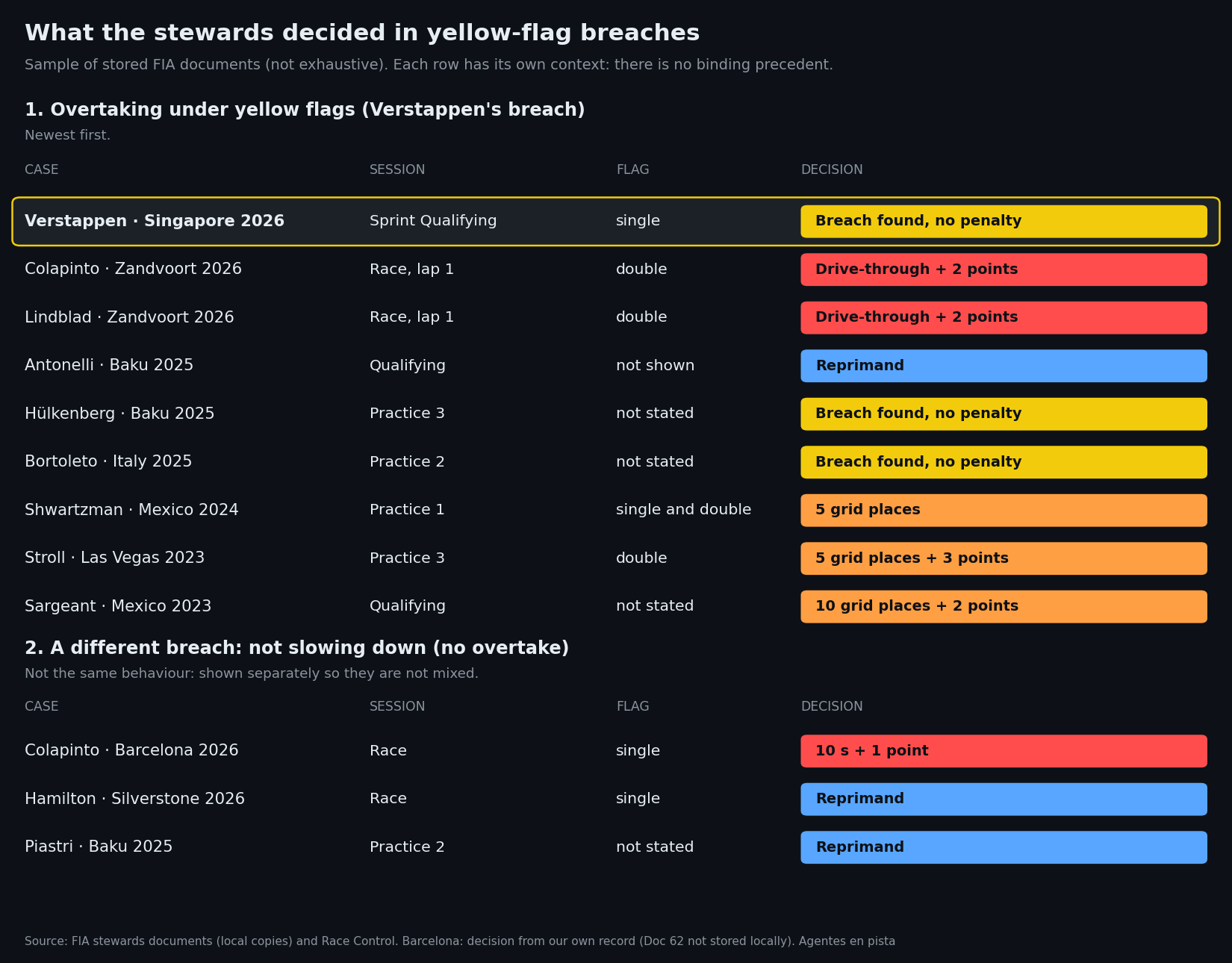
VER against Colapinto in Zandvoort. What the flag demands changes the context: double means a “hazard wholly or partly blocking the track”; single, “beside or partly on the track”. Both drivers were found in breach for overtaking under yellow and both panels wrote a mitigation; the effect differed (no penalty versus one step down). These are two documents with a different panel, flag, session and context: two cases do not allow a criterion to be inferred. “The text mentions no hearing” does not mean “there was no hearing”: only Doc 29 records in writing that the driver was summoned and heard. Doc 63 does not discuss avoidability: we do not claim that Colapinto’s overtake was avoidable or unavoidable.
| VER, Singapore SQ (Doc 29) | COL, Zandvoort race lap 1 (Doc 63; Lindblad, Doc 62, identical) | |
|---|---|---|
| Flag / article | single / App. H 2.5.5b | double (T14 sector) / B1.8.4b |
| Context | qualifying push lap; Car 44 ahead, braking to “less than 60km/h” | last corner of lap 1 of the race; “significant amount of debris on track” |
| Fact per the stewards | passed HAM before T8 with both cars still in the yellow sector | “overtook Car 22 in the double yellow flag sector before the Line at the end of Lap 1” |
| Written mitigation | the pass as an “unfortunate consequence” of the speed difference; VER “reacted appropriately” | “mitigating circumstances” because of the debris |
| Written effect | “determined not to impose a penalty” | from “normally ... 10 second stop/go” to drive-through + 2 pts |
| Process, per the text | “summoned ... and heard from the driver”; evidence includes radio and telemetry | “having received a report from the Race Director”; evidence: positioning data, video, timing, in-car video. The text mentions no hearing, radio or telemetry |
| Avoidability | discussed: VER says avoiding the pass needed “braked very heavily”; the stewards conclude “unfortunate consequence” | the text does not discuss it |
Raw telemetry of Colapinto’s pass in Zandvoort. There is no comparable clean lap of his own (lap 1 has no previous lap: grid, full tank and debris; the following laps are under red flag or Safety Car), so no throttle delta or traverse percentage is computed. COL enters sector 18 (T14, 3,754-3,972 m) at 13:04:52.1 UTC and passes Car 22 at ~13:04:54.2 (±0.5 s), at ~3,877 m, inside the sector. Speed: COL ~200 km/h, Car 22 ~189 km/h (difference ~11 km/h; between 0 and ~20 given the position error); COL throttle ~49% at the pass, no visible lift or braking in that stretch. Race Control logs DOUBLE YELLOW in sector 18 at 13:04:56, about 1.8 s after the measured pass; this does not prove the flag was not shown (the stewards reviewed marshalling data we do not have and the feed publishes with a delay), and no conclusion is drawn. We cannot say that COL “did not slow” or that he “had no way to avoid it”.
A different breach: not slowing (B1.8.4a or App. H 2.5.5b), no overtake. It is not the same behaviour as VER (VER lifted fully and braked; his breach was the overtake): it is shown separately so they are not mixed. The reaction window is always measured as W1: seconds from the Race Control yellow message to the car crossing the start of the marshalling sector (telemetry and position). For Barcelona the message recording the breach arrives 22 s after the flag (W2, an administrative stamp); it is not used for comparison. In all three cases the data show the same thing (no measurable slowing) and the decision tracks the window: 18.4 s with other drivers reacting, 10 s + 1 pt; a window near zero or before the flag, a reprimand. Silverstone (Doc 75): “entered the relevant sector before any yellow flag or yellow light panel was displayed”. Baku 2025 (Piastri): “yellow flag was withdrawn less than one second after the green light became visible to the driver”. Doc 62 of Barcelona is not stored locally: its text is not quoted.
| Case (a different breach: not slowing, no overtake) | Decision | Throttle delta, 60 m (pp) | Sector traverse | Flag-to-physical-entry window (W1) |
|---|---|---|---|---|
| Colapinto, Barcelona 2026, race, sector 10 | 10 s + 1 pt (B1.8.4a) | -0.2 | -3.5% (previous lap) / +0.3% (clean) | +18.4 s |
| Hamilton, Silverstone 2026, race, sector 10 (Doc 75) | Reprimand | -0.1 | +3.2% / -1.0% | -4.2 s (entered before the yellow message) |
| Piastri, Baku 2025, practice 2, sector 2 | Reprimand | -7.7 | -2.0% | -4.1 s |
Verdict of the analysis: defensible given the document and the telemetry, but not demonstrably consistent with earlier cases
The team’s reading, not a data point. The decision is defensible given what the document and the telemetry say, but it cannot be shown to have been consistent with earlier cases.
In favour. (1) The telemetry supports the account: he came fully off the throttle (delta -67 to -96 pp in the previous 60 m), passed 65-74 km/h below his clean laps and HAM was braking at 57-62 km/h (Doc 29 says under 60). (2) There are no-penalty decisions with a written mitigation (Italy 2025, Baku 2025), although each mitigation differs from Singapore’s. (3) A process with a hearing, radio and telemetry according to the text, and the breach found.
Open. (1) The 2026 guidelines provide 5 grid places for overtaking under a single yellow in qualifying; the stewards keep discretion for mitigation and here decided not to impose a penalty. (2) The central mitigation (avoiding the pass “would have required him to have braked very heavily”) is the driver’s argument accepted by the panel; the telemetry does not measure avoidability. (3) The speed differential is partly due to VER being on a push lap. (4) 40 m in the document against ~89 m measured, unresolved. (5) Two Zandvoort cases do not allow a criterion to be inferred. (6) The precedent sample comes from stored documents and is not exhaustive. (7) VER’s and HAM’s radio was not reviewed; Doc 29 says HAM “had been warned”: when is pending.
Limits. Position error ~10-20 m; 4-5 Hz; n = 4 drivers on a push lap; Race Control has 1 s resolution, so the flag-to-lift time (+2.2 s) includes that uncertainty plus the latency of flags and panels; the stewards saw video, radio and in-car footage and here we have only telemetry and Race Control. No press was used. We do not claim that it was a mistake, that there was favouritism, or that it was the right call.
The telemetry supports that he reacted. What cannot be measured is whether the overtake was avoidable.